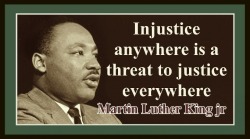
Some - perhaps many - Americans like to think that our nation has entered a "post-racial" era, where racial prejudice and discrimination is just a thing of the past. After all, people of diverse racial and ethnic backgrounds have risen to positions of prominence in government (up to and including the presidency), business, the medical and legal fields, and just about any other position of status you could think of. But does that make us "post-racial?"
Three news stories of the past week raise the question of exactly how far we have actually come since the civil rights movement. Fifty years is a long time, but is it enough time to erase the preceding centuries of prejudice and discrimination? Is it enough time to truly level the playing field of "White privilege?"
It seems unlikely, and each of our lived experience is likely enough to tell us that, although we do tend to consider people of varied races and ethnicities "equal" - equally intelligent, equally able, equally moral, equally "human" - we also judge each other according to negative stereotypes. These judgments don't just go in one direction - everyone seems to have them toward racial/ethnic groups other than their own.
Some folks would like to sweep these judgments under the rug - claim that signs of equality (such as people of color who hold positions of power) represent the absence of prejudice. These folks see this week's Supreme Court decision on the Voting Rights Bill as further evidence that racial injustice is a thing of the past. However, others, including the ACLU and NAACP, warn that the Court's decision poses a risk precisely because of the continued existence of prejudice.
So, what exactly did the Court say? The Voting Rights Bill was first passed in 1965, and renewed in 2006. This bill required specific States, counties, and municipalities to have any changes to voting policy, including districting, approved by the Justice Department ahead of time. The Supreme Court threw out the list of places required to obtain this "preclearance," not because targeting certain places is in itself unconstitutional, but because the list was based on evidence gathered in the 1960s. In other words, the Court did NOT say that such oversight is no longer needed. Instead, they said that Congress needs to determine WHERE such oversight is needed on the basis of current evidence, rather than 50-year-old data. The clear implication is that current evidence would indeed show some places in our country where the racial climate warrants judicial oversight to ensure voter rights.
The Supreme Court is one of the three news stories I mentioned earlier. What about the other two?
The first illustrates our attempt to repudiate our racial past. Paula Deen, a famous cook, tv personality, and author, lost the vast majority of her contracts (for tv, books, and product endorsements) after admitting in a deposition that she has used the "n-word" in the past. Now, Paula Deen was born in Georgia, in 1947. In other words, she grew up in the deep South prior to the Civil Rights movement. I would have been shocked if she HADN'T even used the "n-word." It is ludicrous to judge her so harshly for being a part of the culture of that time and place. It certainly should not be taken as evidence that her current beliefs and behavior are racist. My psychodynamic side wonders whether we, as a society, are attacking in her what we are trying to deny about ourselves and our own societal history.
The last of this week's news stories is an illustration of how racial prejudices continue to shape our collective psyche. George Zimmerman, a Florida man who is half-White and half-Latino, has gone on trial for shooting an African American teenager named Trayvon Martin. As a member of the neighborhood watch, George Zimmerman is reported to have followed Trayvon Martin, while calling the police to report a "suspicious" person, before a confrontation during which Zimmerman ended up shooting and killing Martin. While the defense is claiming self-defense, the prosecution claims that Zimmerman racially-profiled Martin, assuming he was a criminal because of his race and gender.
The outcomes of all three of these news stories are yet to be determined. However, what they demonstrate (at least from my perspective) is that our society is desperate to distance ourselves from any hints of racism, at the same time these hints belie the myth that America is "post-racial." We're just not there, yet; and it's going to be pretty hard to get there if we can't acknowledge and talk about it!
A collection of reflections for those learning and practicing psychotherapy, and clinical social work more generally
Showing posts with label Diversity. Show all posts
Sunday, June 30, 2013
Thursday, November 29, 2012
Embracing Difference: Lessons from "How to Train Your Dragon"
I recently watched the movie "How to Train Your Dragon" for the first time (I know, it's not exactly a new movie!). It has all the necessary ingredients of an animated classic: endearing characters, cute animals (ok, dragons), adults who just don't understand, allusions to a literary classic (The Little Prince)...and a deeper lesson.
The lesson of "How to Train Your Dragon" is about difference (one of social work's favorite themes). The main character, Hiccup (yes, that's his name!), is considered "different" than the rest of the Vikings (his people). Specifically, he is considered too weak and scrawny to fight dragons, and fighting dragons is the primary "career track" for the Vikings. As a result, his father (the chief) tells him he needs to be less...him.
The Vikings don't just stereotype Hiccup; they have a real prejudice against dragons. Specifically, while they recognize that there are many breeds of dragon, they consider them all "extremely dangerous - kill on sight."
However, like most prejudices, it blinds the Vikings to the dragons' true nature. The dragons are afraid of the Vikings (who wouldn't be, what with all the attempts to kill on sight!), and terrorized by a giant monster of a dragon living nearby, but generally docile, intelligent, and quite friendly once they know you're not trying to kill them.
It takes someone different (Hiccup) to recognize that the dragons are just as misunderstood as he is. And it take the dragons coming to the rescue during a crisis for the Vikings to recognize that Hiccup is (1) right about the dragons, and (2) valuable just the way he is. In the process, both Hiccup and his dragon (named Toothless) lose part of a limb, but it is clear neither is any less whole for being "differently able." It's an added nice touch that, as Vikings and dragons unite at the end, the differences between breeds of dragon match each uniquely well to the builds and personalities of specific Vikings.
It is heartwarming. But the message is also an important one, closely linked to the values of the social work profession: There are differences we can see, and differences we cannot see, and all forms of difference enrich rather than endanger our communal lives, as long as we can look past our own prejudices.
The lesson of "How to Train Your Dragon" is about difference (one of social work's favorite themes). The main character, Hiccup (yes, that's his name!), is considered "different" than the rest of the Vikings (his people). Specifically, he is considered too weak and scrawny to fight dragons, and fighting dragons is the primary "career track" for the Vikings. As a result, his father (the chief) tells him he needs to be less...him.
The Vikings don't just stereotype Hiccup; they have a real prejudice against dragons. Specifically, while they recognize that there are many breeds of dragon, they consider them all "extremely dangerous - kill on sight."However, like most prejudices, it blinds the Vikings to the dragons' true nature. The dragons are afraid of the Vikings (who wouldn't be, what with all the attempts to kill on sight!), and terrorized by a giant monster of a dragon living nearby, but generally docile, intelligent, and quite friendly once they know you're not trying to kill them.
It takes someone different (Hiccup) to recognize that the dragons are just as misunderstood as he is. And it take the dragons coming to the rescue during a crisis for the Vikings to recognize that Hiccup is (1) right about the dragons, and (2) valuable just the way he is. In the process, both Hiccup and his dragon (named Toothless) lose part of a limb, but it is clear neither is any less whole for being "differently able." It's an added nice touch that, as Vikings and dragons unite at the end, the differences between breeds of dragon match each uniquely well to the builds and personalities of specific Vikings.It is heartwarming. But the message is also an important one, closely linked to the values of the social work profession: There are differences we can see, and differences we cannot see, and all forms of difference enrich rather than endanger our communal lives, as long as we can look past our own prejudices.
Sunday, April 29, 2012
Why We Hate...and How to Stop
The worst side-effect of our polarizingly partisan politics is how it makes us feel about each other. Or, more precisely, how it makes us feel about the Other - those from social groups to which we do not belong. The further we are divided from one another, the easier it becomes to hate the Others.
We've seen it throughout history, all the way back to Cain and Abel. People have hated each other on the basis of race, gender, age, religion, nationality, sexuality, and innumerable other aspects of social location we think we can judge based on appearance or behavior (clothing, car, weight, education, profession, etc, etc). This kind of hatred has led humans to commit all kinds of atrocities in the name of their own "tribe" - think about the Crusades, the Inquisition, the Holocaust, and multiple more recent Genocides...to say nothing of all the smaller-scale ways we damage each other's bodies, minds, and spirits.
While there have been...interesting...studies done on how people can be convinced to take part in torturing others (e.g., Milgram's famous study), I am more interested in how we end up hating and harming each other in our daily lives, and by extension, through our politics (or is it the other way around?).
The biggest reason for hatred seems to be that we feel threatened by the Other. This dynamic is visible whenever a group of people declares that their whole way of life would be threatened by letting the Other group vote, or marry, or attend the same schools, or whatever the issue happens to be. Most recently, for example, conservative groups have declared same-sex marriage to be a threat to the integrity of heterosexual marriage. I am baffled, myself: how does recognition of one sort of relationship negate the value of another sort of relationship?
Perhaps it has something to do with the dynamic captured by Jewel's song, Pieces of You:
She's an ugly girl, does it make you want to kill her?
She's an ugly girl, do you want to kick in her face?
She's an ugly girl, she doesn't pose a threat
She's an ugly girl, does that make you feel safe?
Ugly girl, ugly girl, do you hate her cause she's pieces of you?
She's a pretty girl, does she make you think nasty thoughts?
She's a pretty girl, do you want to tie her down?
She's a pretty girl, do you call her a bitch?
She's a pretty girl, did she sleep with your whole town?
Pretty girl, pretty girl, do you hate her cause she's pieces of you?
It seems like our group memberships/identities are so important to us that the recognition of similarity with the Other - even a small glimmer of commonality - threatens our whole understanding of who we are and how we fit into the world. We get the sense that, if the Them/Us dichotomy is false, then much of how we understand the world might also be false, and the whole thing might just topple like a house of cards. We get anxious and fearful, and almost instinctively try to distance the Other from us in some way - often a way that is cruel.
The solution to this kind of hatred is both simple and difficult, because it involves no more or less than approaching (rather than distancing from) the Other. By getting to know one another, recognizing the similarities born of our common humanity, and the differences that enrich rather than threaten our society, we gain mutual respect, and lose our willingness to tolerate cruelty.
Whom will you choose to approach? What hatred will you challenge?
Monday, January 16, 2012
Looking for Justice
Today, we observe the birthday of Martin Luther King, Jr. as a reminder to continue working toward the ideal of "liberty and justice for all." In his famous "I Have a Dream" speech, King wrote:
... we refuse to believe that the bank of justice is bankrupt. We refuse to believe that there are insufficient funds in the great vaults of opportunity of this nation. So we have come to cash this check — a check that will give us upon demand the riches of freedom and the security of justice. We have also come to this hallowed spot to remind America of the fierce urgency of now. This is no time to engage in the luxury of cooling off or to take the tranquilizing drug of gradualism. Now is the time to make real the promises of democracy.
So, how are we doing, almost 50 years later, on that justice thing? It depends, of course, whom you ask. It also depends on whether you see the metaphorical glass as half-empty or half-full. I tend to see it more as a dialectic: it is true both that we're working toward justice, and that we've got a long way to go.
That points to the negative side - it is still true that the majority of power and resources are in the hands of a small group of people...a group that is largely wealthy, White, and male. The Republican primaries are an excellent illustration of that (with the big concession to diversity being Romney's Mormon faith). While there is slightly more racial and gender diversity in the Senate and House of Representatives, our politicians tend to be uniformly wealthy. The degree to which they are out of touch with the rest of the population is clear in the stalemate they've created through petty refusals to compromise, and the resulting all-time low approval rating on 9%.
A part of the mission and responsibility of social work is to advocate for the needs and rights of our clients, many (if not most) of whom face unequal treatment as a result of race, class, or (dis)ability. Mental illness still carries a heavy stigma, and our health insurance structure is more geared toward denying care than providing it. We fight an up-hill battle to get our clients' needs met - needs for treatment, as well as more basic needs (e.g., food, shelter, safety, transportation) that may otherwise create barriers to treatment.
How do you approach this challenge in your work? How do you think about your role as an advocate for justice?
Wednesday, August 17, 2011
Playing with a Stacked Deck: Classism and Economic Privilege
When I was in social work school, we read bell hook's* book Where We Stand: Class Matters
I work with clients who are economically marginalized, and I've become acutely aware of my own class privilege. While I have always known that I was "privileged," I used to think that meant 1) I had some nice things I didn't have to work for, and 2) I had educational opportunities that prepared me for a good career. Of course, having educational opportunities is itself much more involved than I realized, including for example: family emphasis on education, living in a good school system, knowledgeable assistance applying for college and scholarships, family support and the lack of responsibilities allowing one to attend college rather than work...and so on.
However, I have recently come to realize that classism is much more complex and insidious. Both personally, as I begin preparing to buy a home, and professionally, as I explore the economic barriers my clients are facing, I have recognized more subtle ways that classism operates. Neither economics nor personal finance are self-explanatory. Money management - balancing a checkbook, establishing a budget, spending and saving responsibly - is a skill that has to be taught and learned. Part of my "privilege" is having been taught these skills from early childhood; my clients whose parents barely scraped by learned very different lessons, often about borrowing from Peter to pay Paul.
And good credit is more than just paying your bills on time - more than any other thing, FICO strikes me as method of perpetuating class divisions. I was told as a teen that I would need to use credit to establish a credit history; many people aren't told that. I got credit by having credit-worthy cosigners; many people don't have that. Then there's the mystique of the credit score itself, little secrets like: a credit check lowers your credit score, as does carrying a balance of more than a third of your credit limit, while maintaining an account over an extended length of time increases your score. If you don't know that these kinds of things are factors in your credit score, you wouldn't even think to wonder. Then there's something that wasn't explained to me: a factor in obtaining credit is your debt to income ratio, so student loans are not as benign as I was led to believe. APRs, stocks, bonds, mutual funds, and retirement accounts are also confusing, and often counter-intuitive.
Like a secret handshake, these little pieces of information allow those of us with class privilege to attain and maintain financial independence, while those who haven't been initiated into the secrets by virtue of upbringing or education struggle without being able to figure out what they're missing. This is classism, and economic privilege: we're all playing with a stacked deck, and while we may all realize that it's stacked, only some of us know how it's stacked.
* Note that bell hooks chooses not to capitalize her name
Sunday, August 14, 2011
The Golden Rule?
In interviewing potential social workers, the CEO of the health center where I work always gives a standard speech: the case managers - paraprofessionals who are members of our clients' cultural/linguistic groups, and serve as culture brokers in addition to connecting clients with concrete services - must be treated with equal respect as any professional.
To me, this rule seemed obvious - why wouldn't I treat them with respect? However, he wouldn't say it unless some previous staff member had been disrespectful. This fact got me thinking about how we, social workers or other professionals, treat each other.
We're taught (repeatedly) about the importance of respect and sensitivity toward all forms of diversity in our clients - race, ethnicity, class, age, gender, sexual orientation, ability, religion. However, there is little talk about the importance of showing each other the same respect.
How often do we judge each other on the basis of the same kinds of diversity we make such a point of accepting in our clients?
I know that I have faced prejudice from colleagues and potential employers because I identify as Christian - they assume or fear I represent the "religious right" rather than my actual progressive Christianity. Other people I know have faced other forms of discrimination: Male social workers are assumed to be gay. Persons of color are sometimes assumed to be less educated. The very presence in the profession of those of us with any history of mental or emotional problems is questioned. Not to mention physical disabilities: You can't work on a psych unit if you can't participate in restraints! Or, how can you be a therapist if your hearing or vision is impaired?
If we step back and imagine making the same assumptions of clients, we are appalled, and yet we readily say or think these things about each other. What scares me is that, if we think these things of each other, are we really not harboring the same attitudes toward clients? That was my reaction to our CEO's speech - any professional who treats the case managers disrespectfully may very well be treating clients just as disrespectfully.
So, let's try to extend the same respect and acceptance toward each other that we aspire to show our clients, and that we hope to receive ourselves. We may be surprised by how it enriches our profession for everyone to feel free to bring all of themselves to the work.
Subscribe to:
Comments (Atom)