Showing posts with label Social Justice. Show all posts

Monday, September 3, 2012

Labor Unions in Social Work?

Today is Labor Day in the U.S. - a day set aside to recognize and the American worker. The holiday is indelibly linked with the nation's history with labor unions, organized groups of workers than band together to increase their bargaining power and relative influence compared with "management."

On the whole, labor unions have made a positive contribution to society by successfully combating abusive working conditions, hours and pay. However, there is also a down side to unions. One that has made headlines in the current recession is that unions can make it very difficult for employers (both private companies and the government) to adjust to meet economic demands. If you have to give everyone raises (in spite of shrinking profits), offer the most expensive health insurance, and other fringe benefits (holidays, vacation, retirement matching...whatever), etc., your only option is to lay off workers (even if you need a certain number of staff to continue operating). Suddenly, unions don't seem quite as great, when they directly cause some of their members to lose their jobs.

And when it isn't a factory that can't put out as many widgets as it used to, but instead a service we depend upon - for example, having enough teachers, police, firefighters - it's not just the people who lose their jobs that pay a price, but everyone. Now, don't get me wrong: I'm not anti-union, and I'm not advocating that we abolish them (lest we revert to abusive employment practices). What I am saying is that we should be conscious of both the benefits and the costs.

So what about unions in the Mental Health field? They exist - I know because I am in one. One of my jobs is unionized. That means that everyone who isn't "management" either has to join - pay union dues and get a vote - or decide not to join, still pay for the privilege of "benefiting from collective bargaining" but not get a vote. So, I joined.

Like unions more generally, unions in Mental Health seem to be a mixed bag. The union has done important lobbying and advocacy on behalf of Mental Health services and clients/consumers, working to keep these services in the State budget, and advocate for legal changes such as parity, and safety regulations for staff. This sort of action speaks to the heart of Social Work's mission and values. I also think the union is good to have to ensure fair treatment of nonprofessional staff, who have little training and make low wages overall.

However, when it comes to clinical staff, I think the union is more a hindrance than a help. Because the union is based on the idea that there is a clear division between "workers" and "managers." That means that unions also make it pretty hard to progress up the chain from worker to manager - from clinician to supervisor. Unions don't want to lose members (as they do when someone is promoted), and they don't want to lose a position - they don't want an existing position that is considered "union" to become management. For someone to be promoted, someone else has to be hired for the vacated union position. If the company can't afford to hire additional staff...well, no promotion is likely. I lost an opportunity for promotion because the union would not release my position, and it was very frustrating - especially when I have been paying union dues all along!

Then there is the issue of client care. During the last round of contract negotiations, when the company I work for argued that they could not afford to pay everyone a 3% raise, and continue to pay the % of health insurance premiums the union was demanding, the union voted to strike. When it comes to human services, strikes seem wrong to me. It's basically saying that the monetary dispute between the union and management is more important than client care. Particularly when it comes to therapy, it's not like someone can really substitute for a striking worker. Unions figure that clients who don't get services become another voice to pressure management into agreeing to the unions terms...but at what cost to the clients? What is the impact on high-risk populations, or those who have attachment issues? It doesn't seem responsible to me. Thankfully, a negotiation was worked out prior to the scheduled strike at my company last year...but if the strike had happened, I would have worked regardless. There are more important things than pay and benefits.

Saturday, August 25, 2012

Parity

For a long time, insurance companies set a limit on the number of therapy sessions their members could receive each year, and refused to pay for additional sessions, regardless of the client's condition or need. Typically, the maximum was 24 sessions or less a year. That adds up to less than every other week - certainly less than the weekly sessions most therapists and clients prefer.

Insurance policies still specify these session limits, but thankfully, many clients are now exempt, thanks to legislation requiring "parity." Basically, the law now requires that mental health problems with a "biological" basis receive coverage equal to that provided for (physical) medical conditions. In other words, if the insurance company would not put a session limit on the number of times you could see a physician for diabetes, it cannot then limit the number of times you see your therapist for Bipolar Disorder.

This is good news for therapists - we can now see clients as frequently as they need to be seen, rather than disrupting the momentum of treatment with inconsistent session, and/or breaking off treatment when it is still needed...if they have a problem classified as "biologically based."

That, of course, raises all kinds of new issues. For example, while it is usually relatively clear that a medical condition has a biological basis, it can be harder to determine which mental or emotional conditions have a biological cause or component. Postmodern, constructionist theories suggest that diagnosis and etiology are to a large extent an extension of socially agreement rather than objective "fact." Thus, our diagnostic categories may be more about what DSM committees agree upon than about clear biological distinctions.

When we make decisions about which diagnosis to assign and/or bill for, there's often more than one that may be appropriate. Since NOT all diagnosis are covered by parity, it behooves us and our clients to familiarize ourselves with the federal and state parity laws. For example, Major Depressive Disorder is classified as a biologically-based condition, but Dysthymic Disorder and Depressive Disorder NOS are not. Diagnositc decisions therefore carry a lot of weight. Similarly, when it comes to billing, if someone has multiple diagnoses, but only one is classified as "biologically based," you would want to list that one as the primary billing diagnosis (since if you list the other, your claims will be denied after the session limit has been reached).

Overall, parity is a good thing: it allows clients to receive needed services much more consistently than before the law was passed. However, it does raise important questions about the nature of mental and emotion issues, the nature of (mental) healthcare, and the way we define diagnosis and etiology. We have many more questions to answer before we call really say that we have achieved "parity."


Thursday, June 28, 2012

Weight-y Stereotypes

I spend a lot of time telling clients that "people, as a species, are terrible at mind-reading." And, in general, I really do believe that we are notoriously inaccurate when it comes to reading minds.

Typically, I say this kind of thing when a client is assuming that someone is judging them negatively. Now, I work primarily with eating disorders, and people with eating disorders spend a lot of time comparing themselves to other people - but, almost exclusively, compare what they see as negative about themselves to what they see as positive about others. They also tend to assume other people are making similar comparisons, and recognize their inferiority. Because my clients spend so much time thinking that others share their negative view of themselves, I end up talking about mind reading quite often. 

However, it turns out that my clients' mind-reading may not be as inaccurate as I have chosen to believe. 

There was a segment on the Today Show this week on "the secret ways women judge each other." It presented some disturbing findings about the assumptions we make about each other's character, based solely on weight and appearance. With only their appearance to go on, women were much more likely to describe heavy women as lazy, sloppy, undisciplined, and slow, while describing thin women as conceited, superficial, vain, self-centered, mean, and controlling. AND, women used these descriptions regardless of their own weight - so heavy women still described other heavy women as lazy, sloppy, etc, and thin women described other thin women as conceited, superficial, etc.

This kind of internalized stereotype has a negative effect on our relationships with each other, and contributes to negative self-image and negative body-image. And, as we know from various types of discrimination, widely held negative stereotypes often do leak into our behavior. When it comes to weight, heavier women face very real discrimination, especially in employment, where they are less likely to be hired, and make on average $6,000 (yep) less a year, controlling for all other variables. Think about it: the stereotypes for heavy women don't suggest professional excellence.

Of course, when it comes to clients with eating disorders, mind reading is still inaccurate, since they are not viewing their bodies accurately, and therefore make inaccurate assumptions about how others see them. However, I have a new understanding of where this mind reading comes from: if we're all making so many unfounded judgments about each other, it's really no wonder people get a little paranoid about how they're being judged!

I still think mind-reading is dangerous - assuming we know what anyone else is thinking can contribute to negative mood states, and misjudged actions. However, a real solution needs to address the underlying problem - our tendency to judge and make comparisons rather than showing compassion. That's what we, as a society, should really be focused on changing!

Monday, June 25, 2012

The Role of Group Dynamics in Bullying

There has been a lot of news coverage this week about a viral video of a group of middle school boys verbally harassing their bus monitor, including cruel comments about her weight, age, and the fact she shed tears in reaction to their comments.

Reactions from the public have been split between vilifying the boys, and collecting donations for the bus monitor. In fact, the boys have reportedly received their share of cruel comments in return, including death threats. One of their fathers appeared on the news, stating that he had not raised his son that way, and planned to take the child to therapy to figure out whether there was something more serious going on with him. A clinician who had not met the boys also got on the news talking about sociopathy.

However, before we pathologize these boys (and possibly create a self-fulfilling prophecy), I'd like to encourage everyone to slow down a bit, and not rush to judgment. Yes, the boys certainly did something wrong, and certainly should have known better. However, their behavior needn't be attributed to sociopathy. In fact, it seems much more likely that the boys were demonstrating a perfectly normal, albeit negative in this case, function of a social group.

Please don't mistake this for condoning their behavior, but let's use it as a learning opportunity for all of us - after all, the public exhibited a similar group dynamic against the boys in retaliation! Here is how I understand it:

In social groups, people are motivated to conform to the group's behavior - in other words, each individual adapts his or her behavior to more closely match that of other group members. We all do this, for a variety of reasons: we want to fit in, be liked, or at least not actively disliked; we want to be right (and assume the rest of the group is right); we want to belong - experience ourselves and be experienced by others as part of the group. The pressure to conform is quite powerful. For example, in one research study, Dr. Asch put one participant into a group of confederates (i.e., people helping the researcher, but unidentified to participants as such). Then he showed the group a line, and asked which of three other lines was the same length. It wasn't one of those optical illusions - it was supposed to be obvious which answer was correct, but the confederates intentionally gave an incorrect answer. 76% of participants agreed with the wrong answer at least once, and on average participants conformed with the group about a third of the time. And this was with adults - the pressure to conform, as we know, is much greater for young adolescents!

Sometimes this (natural) conformity leads us in positive directions, and sometimes it leads us in negative directions. What would cause it to be negative (such as group bullying)? There are various theories on what may contribute. In an earlier post on hazing, I described some possible influences, such as groupthink, and social roles. Other factors include group contagion (one person has a negative idea/impulse, which s/he may or may not consider acceptable individually, and others in the group go along with it, which validates it as acceptable to everyone), and deindividuation (people lose their sense of separate from the group, and therefore their independent evaluation of group behavior).

Add to this the boys' developmental stage, which often includes challenging the authority of adults, and I imagine the scenario thus: Somebody says something disrespectful, but not all-out mean. The bus monitor does not respond (perhaps trying to avoid reinforcing the behavior through a response). When the first boy "gets away with " being disrespectful, some other boy wants to look cool/conform, and says something a little more disrespectful. Peers reinforce the behavior by laughing, gasping, whatever - and so it continues to escalate. Each of them probably had at least one moment of thinking "this is wrong," but it was likely followed by thinking "everyone else is doing it, so maybe it's not wrong," or "if I don't at least laugh along, they're going to think I'm a loser; maybe they'll even do the same thing to me!"
I bet most of us have been in situations that felt like this - gone along with something we suspected was a bad idea. So, let's have a little compassion. Let's not use groupthink and anonymity to lash out against these children. Let's teach them, and others, that you don't always have to "go along to get along."That you can't check your moral compass at the door when you enter a group. And that we (as a group) should respect courage rather than conformity...but sometimes we don't.

Tuesday, April 3, 2012

Disenfranchized: Race, Class, and "Equal" Rights

I heard a very interesting interview on the radio yesterday about racial inequality as it currently exists in the U.S. This topic has obviously come to the forefront of popular attention recently as a result of the shooting death of 17 year-old Trayvon Martin in Florida, for which the shooter has not (yet) been charged. In the wake of this death, people of color have been talking about how their communities have to teach young people, especially boys, how to behave with police and other authority figures to lessen the perception of threat, at the same time that we're all working to break or change cultural stereotypes that perpetuate fear.

However, the interview I heard yesterday highlights the much more systemic and insidious nature of institutional discrimination on the basis of race (and, I would add, class) arising out of our legal system. The interview was given by Michelle Alexander, discussing her book The New Jim Crow: Mass Incarceration in the Age of Colorblindness. Her argument is that people of color are incarcerated at much higher rates that Caucasians for all sorts of crime, but she particularly highlights the discrepancy of arrests and convictions on drug charges. While plenty of young white people use marijuana and other illegal substances, they are much less likely to be arrested and convicted, while people of color all too often end up with felony convictions.

And here is the kicker: anyone with a felony conviction is systematically and permanently disenfranchised in our society. They are ineligible to vote in many states, are excluded from many jobs, can't get student loans, food stamps, or housing assistance. In other words, no matter how much they want to improve their lives, they are unable to do so: they can't get entry-level jobs in a competitive economy, they can't educate themselves for a career, and they can't get government assistance to meet even the basic needs for food and shelter when they have no income. What alternatives does someone have in this position? Keep applying for jobs hoping to get lucky, and/or work illegally - off the books, if they're lucky, or dealing drugs, etc., if they're not as lucky.

This disenfranchisement is real. I have seen it affect the lives of many clients. It is also largely racial, since there is stark inequality in the rate of people of color who are arrested, tried, convicted, and sentenced. However, I think it's also worth mentioning the role of social/economic class. There is always a lot of overlap between racism and classism, since racism has resulted in a disproportionate number of people of color experiencing poverty; however, this overlap is not complete, and poverty continues to affect a wide range of people of all races. Poverty obviously has a significant impact on environment and opportunities, including opportunities to obtain education and work experience that are necessary to change one's environment. People living in poverty are often surrounded by crime and drugs. Crime because people either have no other way to meet their basic needs, or feel they don't owe anything to a society that has given them nothing, and drugs because people want an escape from their circumstances, and as a way to make money without education or work experience. Without opportunities to change one's environment, it's very hard for young people to avoid at least experimenting with drugs and/or crime, particularly during the hopelessness that accompanies initial awareness of inequality and lack of opportunity. Experimentation obviously opens the door for arrests, and the disenfranchisement discussed above.

We like to see prison as a form of "rehabilitation;" however, if we permanently deny rights and opportunities following release from prison, how can any form of rehabilitation be maintained (assuming that there was something "wrong" with the person to begin with, rather than the societal problems I'm discussing)? As a therapist who has worked in the inner city, it's incredibly disheartening to sit with someone and know that there are so many things that can't change for the better for a client, just because he or she has a record. I urge you, as you place your vote in this year's primaries and election, or even as you go to work in the morning, to think about the people who will never have those opportunities. Our system is broken, and if we believe we're a society of equality, we're more than colorblind. What should we as social workers be doing to fix it?

Wednesday, January 18, 2012

The Medical Necessity Catch-22


Last month, I expressed frustration with insurance companies' reluctance to cover medically necessary treatment just because the client was experiencing (normal) ambivalence about behavior change. This week, I am (yet again) frustrated with an insurance company's initial refusal to cover treatment, this time for the opposite reason.

To be fair, they did pay for 7 weeks of inpatient and residential treatment thus far - due to the severity of the client's anorexia and the risk of death or medical complications as a result of very low weight. She was one of several patients discharged from residential last week because of contagious illnesses, with the understanding that she would re-admit once she was feeling better. Still at a dangerously low weight, with abnormal labs - but miraculously not having lost weight since discharge, in spite of illness - the insurance initially declined to authorize her readmission. Their rationale? She IS motivated for recovery, didn't lose weight and her electrolytes were within normal limits. 

Wait, didn't they just tell me they only wanted to pay for treatment for motivated clients? 

This client had gone to some pains to prevent weight loss and normalize labs because she was afraid she'd wide up inpatient instead of residential. Had her hard work basically undermined her ability to qualify for treatment at the appropriate level of care (i.e., residential)? What message does that send to clients, and at what risk?

Thankfully, when I appealed the decision, they did ultimately approve her readmission to residential. However, I'm still frustrated. Refusing to pay for treatment because clients are too motivated (in this case, claiming she could recover with less intensive treatment because she was motivated), or because clients aren't motivated enough, puts clients and clinicians in an uncomfortable catch-22. Whatever the client does, s/he gets the short end of the stick. 

For clinicians, we're faced with the daunting task of walking the tightrope in advocating for our clients: we need to frame the clinical information we provide to insurers to highlight just the right degree of motivation and progress. Too far in either direction, and our clients could be refused treatment. For clients, the danger is that those who are denied treatment for being too motivated or working too hard on recovery will learn that they need to be more symptomatic to get the treatment they want and need. When the symptom could be deadly, that's a serious concern. 

Yet another reason why healthcare reform should be a significant priority!

Monday, January 16, 2012

Looking for Justice


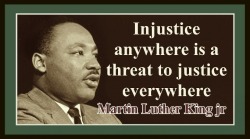
Today, we observe the birthday of Martin Luther King, Jr. as a reminder to continue working toward the ideal of "liberty and justice for all." In his famous "I Have a Dream" speech, King wrote:

... we refuse to believe that the bank of justice is bankrupt. We refuse to believe that there are insufficient funds in the great vaults of opportunity of this nation. So we have come to cash this check — a check that will give us upon demand the riches of freedom and the security of justice. We have also come to this hallowed spot to remind America of the fierce urgency of now. This is no time to engage in the luxury of cooling off or to take the tranquilizing drug of gradualism. Now is the time to make real the promises of democracy.

So, how are we doing, almost 50 years later, on that justice thing? It depends, of course, whom you ask. It also depends on whether you see the metaphorical glass as half-empty or half-full. I tend to see it more as a dialectic: it is true both that we're working toward justice, and that we've got a long way to go.

On the positive side, we've seen an upsurge in community organizing and activism worldwide, from the "Arab Spring" revolutions, to the Occupy movement. The former has not fully realized the goal of justice, but has moved in that direction, with the fall of dictators and the rise of democratic elections. The latter has resulted in consciousness-raising, but few concrete steps toward justice...at least as of yet.

That points to the negative side - it is still true that the majority of power and resources are in the hands of a small group of people...a group that is largely wealthy, White, and male. The Republican primaries are an excellent illustration of that (with the big concession to diversity being Romney's Mormon faith). While there is slightly more racial and gender diversity in the Senate and House of Representatives, our politicians tend to be uniformly wealthy. The degree to which they are out of touch with the rest of the population is clear in the stalemate they've created through petty refusals to compromise, and the resulting all-time low approval rating on 9%.

A part of the mission and responsibility of social work is to advocate for the needs and rights of our clients, many (if not most) of whom face unequal treatment as a result of race, class, or (dis)ability. Mental illness still carries a heavy stigma, and our health insurance structure is more geared toward denying care than providing it. We fight an up-hill battle to get our clients' needs met - needs for treatment, as well as more basic needs (e.g., food, shelter, safety, transportation) that may otherwise create barriers to treatment.

How do you approach this challenge in your work? How do you think about your role as an advocate for justice?